I stopped to help a stranger.
It took three decades to finish.
Act One — 1988
The Sidewalk
I’m twenty-two, walking to work down a San Francisco sidewalk, when I see a woman lying on the pavement. Pregnant. Alone. Begging strangers for help.
Nobody is stopping.
She asks me to call an ambulance. I do. Before it arrives, I deliver her baby on the sidewalk. A girl.
The story made national news. In 1988 it landed me on The Late Show. For a few weeks the papers called me “the student sidewalk doctor.” A TV host asked, “Have you ever considered a job in broadcasting?”
He was telling me I could speak.
Four years later I quit my job and became a speaker. Not because I had a plan. Because that morning had taught me something I couldn’t unlearn: when you lead with your heart, you end up in rooms you never imagined, holding things you never expected to hold.
The baby was the first thing the sidewalk gave me. The thirty years that followed were the rest.
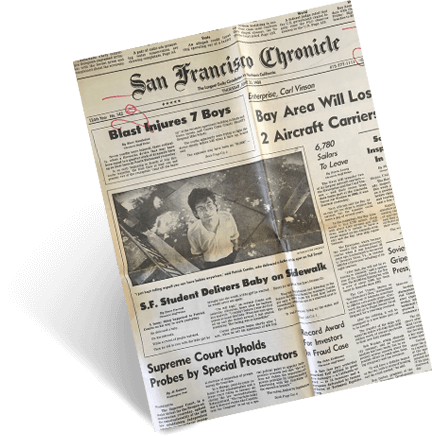
Press coverage, 1988 — “the student sidewalk doctor.”
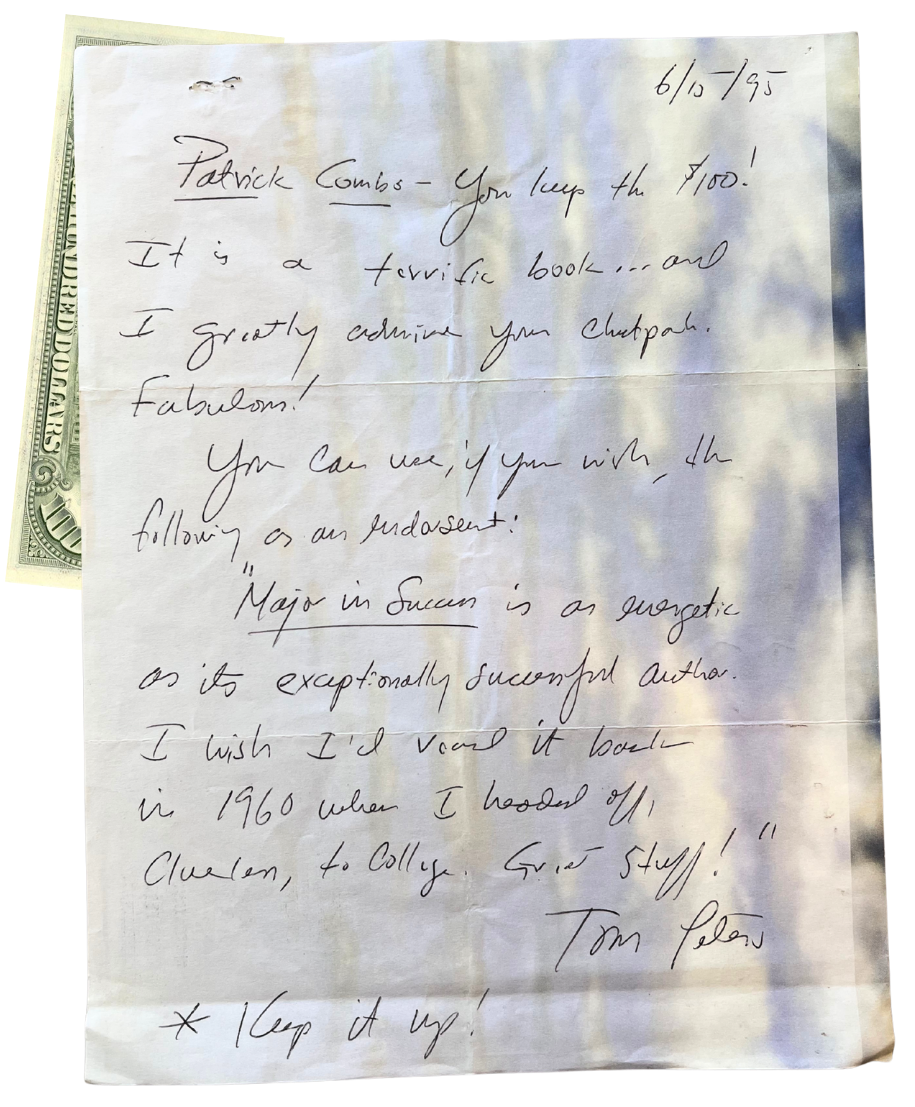
Tom Peters’ reply, June 1995 — with the $100 returned.
Act Two — $100
The Book
At twenty-six, Ten Speed Press published my first book. They asked who I wanted for a jacket quote.
Tom Peters. The top business author in the world. The man whose books had made me want to speak.
I had no shot. No Ivy League network. No author network. My mother was a nurse. Harvey Mackay had already turned me down by form letter, while writing quotes for seemingly everyone else with a pulse.
So I tried something.
I took a $100 bill — gulp — stapled it to my pitch letter, and wrote: I bet you a hundred dollars you’ll love this book. If you don’t, keep the money. If you do, I get my $100 back.
Tom Peters wrote back: You keep the $100! I greatly admire your chutzpah. Fabulous!
And gave me an endorsement.
Five books followed. 150,000 copies. All about purpose, excellence, and having some fun while we’re here.
Act Three — One Million
The Stage
The speaking grew alongside. Hilton, Boeing, Google, Shell, State Farm. Visa, Fannie Mae, Stanford. Fifteen hundred organizations over thirty years, every U.S. state, more than ten countries. A million people, give or take, heard me speak in person.
Ten years in, I was hired to keynote a dozen CEOs from the world’s largest payment processors in Cabo. The night before, I sat in my hotel room surrounded by wadded-up paper, wondering if I could catch a midnight flight home. What was I going to tell men who ran billions of dollars?
What got me out: a rule I’ve used ever since — only speak on what you do as well as or better than eighty percent of your audience.
The next morning, I spoke to them about speaking. They loved it.
Ten years after Cabo, I keynoted Hilton’s leadership conference — 500 GMs and directors of sales, on adding real heart to customer service. The kind of topic that turns woo-woo if you don’t nail it. Afterward, the President walked up.
“You gave us a full day in a single hour,” he said. I asked what he meant. “You made us think, laugh, and cry.”
I’d been working toward those seven words for twenty years.
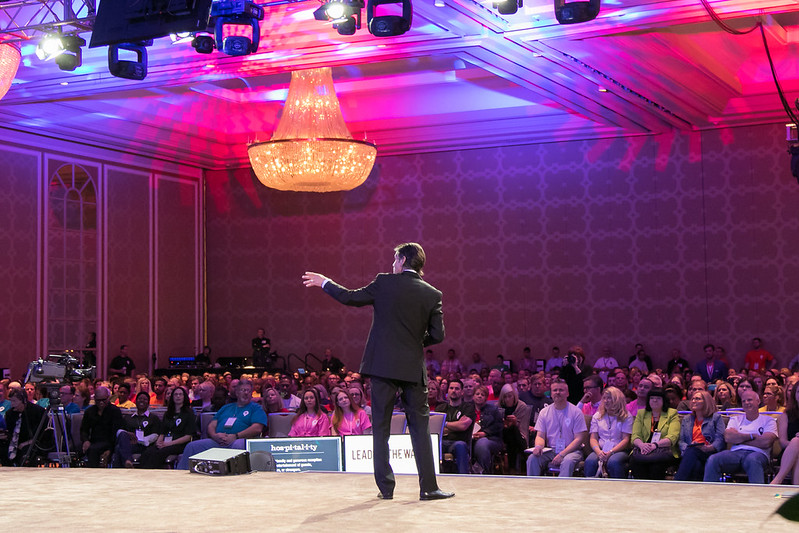
Keynoting Hilton’s “Leading the Way” conference.
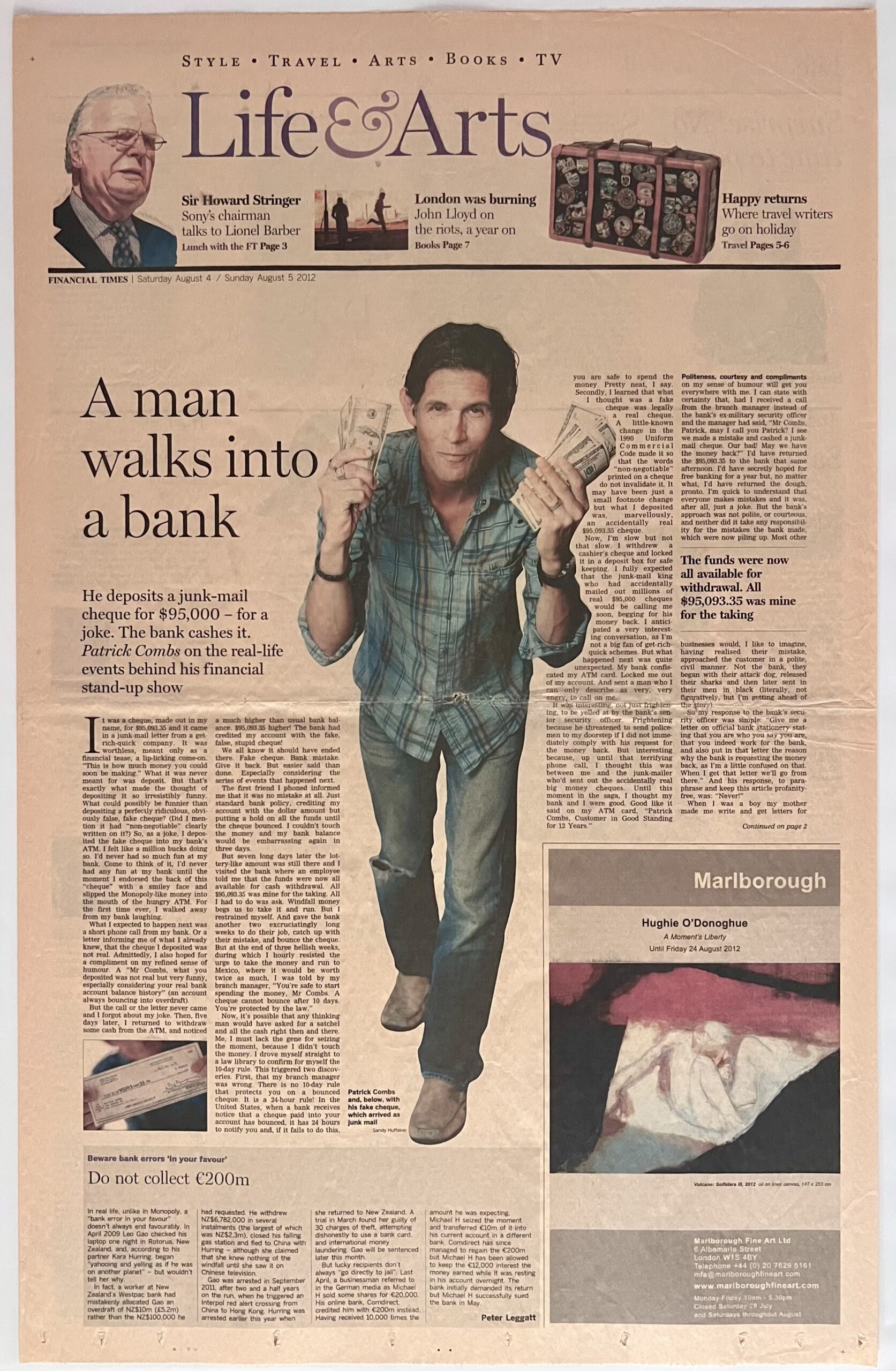
Financial Times, Life & Arts cover, August 2012.
Act Four — $95,093.35
The Joke
Of those thirty years, the strangest one started with a check.
A junk-mail check — designed to look real so you’ll think you’ve won something. This one was made out to me for $95,093.35. Across the front, plain as day: NON-NEGOTIABLE.
I thought it was hilarious. I deposited it in the ATM. A joke. I wanted to make the bank laugh.
The bank didn’t laugh. Three days later the deposit cleared. The bank’s mistake.
I didn’t touch it. I waited.
Much circus followed — the Senior Security Officer who kept calling me “son,” threats of prison for fraud, never mind they’d cashed a check stamped NON-NEGOTIABLE. I gave the money back. I never wanted it. I held out for a letter confirming they’d cashed a fake check. They wouldn’t. For six months they wouldn’t.
The bank’s instinct to protect itself was stronger than its instinct to be honest.
When it was all said and done, I started telling the story on stage.
Friends told me it couldn’t be done. “Stay in your lane. You’re no actor.”
I started anyway.
At thirty-six I opened a one-man show called Man 1, Bank 0. Off-Broadway for a month. The Olympia in Dublin. The Soho Grand in London. HBO’s Aspen Comedy Festival, named the funniest new one-man show in America that year. Edinburgh in 2012. A hundred more mainstages in between.
Variety said I had star power. The London Standard and the Irish Times called me a master storyteller. BroadwayWorld called it “the fastest, funniest show to hit New York in many a season.” The American Banking Association brought me in as a keynote speaker.
Fifteen years on the road. Four hundred performances. One junk-mail check.
Act Five — 2019
The Reunion
I’d been a speaker for nearly thirty years when a Facebook message landed in my inbox.
A thirty-one-year-old woman named Searcy. I was born on June 29, 1988, in San Francisco. I was also adopted in December of that same year. You are the man who caught me as I was born.
I didn’t cry when I read it. I just had something in my eye.
I typed back, I’ve waited forever for this moment. You look so much like your mother. You have her eyes.
She asked if I knew her mother’s name. I did. With it, she finally found her aunts, cousins, brother — a family waiting thirty-one years.
We met. On the spot I delivered her. I told her the story. As I’ve told hundreds of audiences.
But this was the best time — because it’s always about the audience.
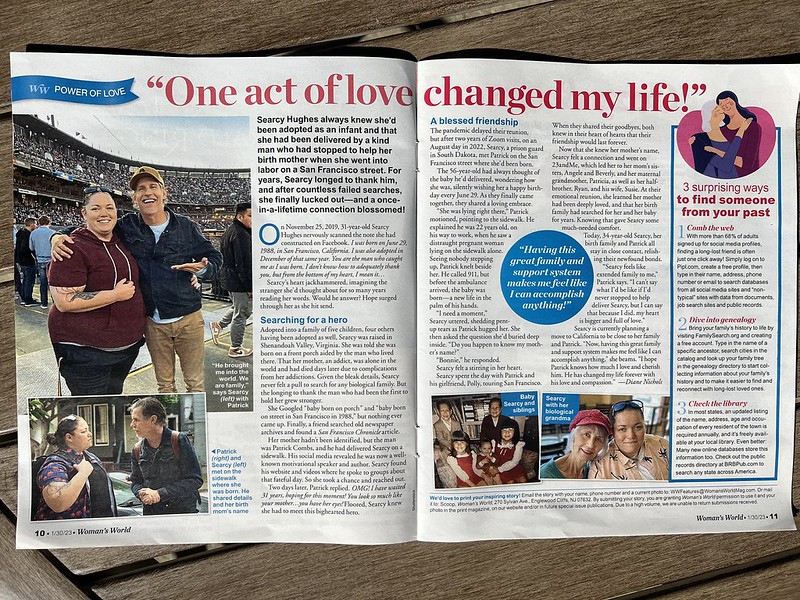
Woman’s World feature, “One act of love changed my life.”